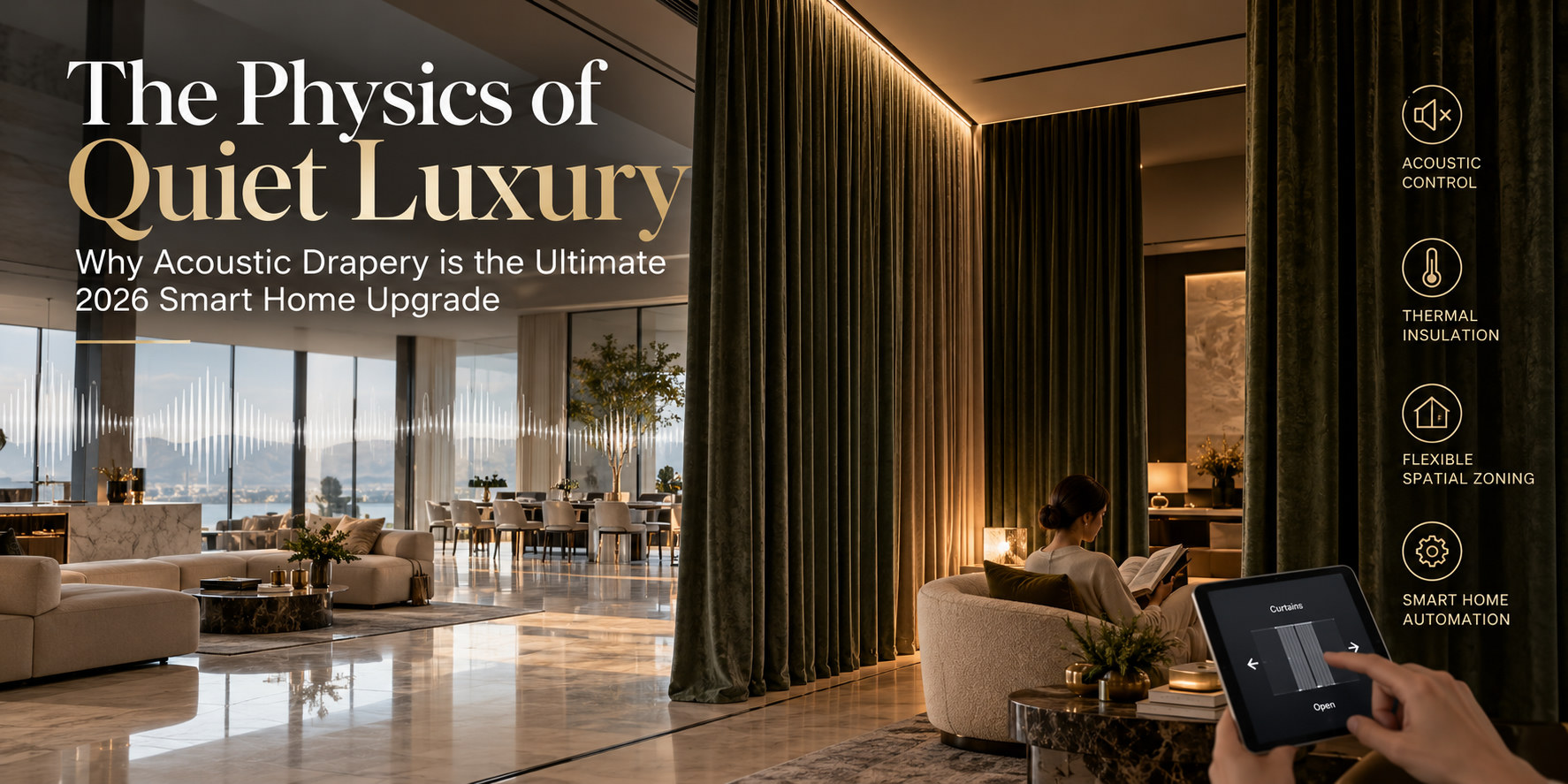
If you step into a modern luxury villa today, you will likely notice two things: breathtaking aesthetics and a massive acoustic problem.
For the past decade, high-end residential architecture has been dominated by the open concept: vast expanses of Carrara marble, polished limestone, and floor-to-ceiling glass. Visually, it is stunning. Auditorily, it is an echo chamber. When hard surfaces reflect up to 99% of sound energy, everyday noises such as footsteps, kitchen appliances, or conversations turn into an overwhelming wall of noise.
As we look toward 2026, the luxury interior design market is undergoing a major architectural shift. Homeowners are rejecting cavernous spaces in favor of the closed floor plan, prioritizing intimacy, privacy, and acoustic isolation. They still want the flexibility of open spaces.
The solution is Quiet Luxury. Not merely a fashion trend, but an engineered, measurable auditory experience powered by heavy acoustic drapery and cutting-edge smart home automation.
Here is how top-tier architectural engineers are blending royal heritage aesthetics with modern physics to create the ultimate sound-dampened sanctuary.
The Secret to Sound Absorption: 32-Ounce Royal Velour
Mainstream interior design blogs often suggest fixing room echoes with lightweight linens or sheer cotton curtains. Unfortunately, the laws of physics disagree. Lightweight fabrics are acoustically transparent; sound waves pass right through them or bounce off them.
To achieve genuine soundproofing and acoustic control, you need mass and porosity. This is why architects specify 32-ounce heavyweight theatrical velour or velvet.
When a sound wave hits this dense material, the microscopic fibers trap the acoustic energy and convert it into heat. In the acoustics industry, this is measured by a Noise Reduction Coefficient (NRC). While standard glass has an NRC of about 0.03 (meaning it absorbs 3% of sound), heavily pleated 32-ounce velour boasts an NRC approaching 1.00, meaning it absorbs nearly 100% of the mid-to-high-frequency sound that hits it.
Engineering the Illusion: Concealed Motorized Tracks
You cannot hang 100 pounds of heavy velvet on a standard curtain rod. When a 15-meter expanse of royal drapery requires full, deep pleating (what the industry calls 100% fullness), the fabric alone can weigh more than 60 kilograms (over 130 lbs).
Moving this much mass requires industrial-grade smart home automation. In 2026, top-tier electronic drive units such as the Somfy Glydea Ultra 60e or the Lutron Sivoia QS D175 are the gold standard. These systems can haul massive weight silently, operating at a whisper-quiet 30 to 44 decibels so the mechanical noise does not ruin the room’s tranquillity.
But true luxury is invisible. To maintain the illusion of historical royalty, architects use advanced aluminum concealment pockets, such as the Blindspace TrackTrim system. These channels are plastered directly into the ceiling during construction. When finished, the motors and aluminum tracks are completely hidden. The heavy fabric appears to cascade, as if by magic, directly out of a seamless ceiling.
Dynamic Spatial Zoning: The 2026 Closed Floor Plan
By integrating concealed, motorized, ultra-heavy drapery, architects are giving homeowners the power to instantly alter the physics of their home.
Imagine hosting a grand party in an open-concept great room. The space feels lively and reverberant. When the party is over and you need to work, you tap a button on your smart home app. Instantly, a massive wall of acoustic velvet silently glides out of the ceiling, bisecting the room.
In seconds, the acoustic volume of the room is cut in half, the echoes vanish, and you are left in an intensely intimate, acoustically “deadened” environment, perfect for deep focus or private conversation.
The cascading royal drapery of 2026 is more than a window treatment. It is a dynamic thermal barrier, a programmable acoustic partition, and a silent testament that the highest echelon of luxury is found where classical elegance meets uncompromising physical science.